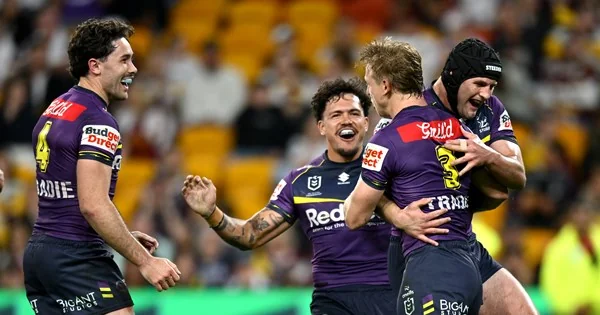
The trial gave the conceding team a choice
The most useful word in the NRL's kick-off experiment is “choice”. The team which has just conceded can choose to receive the restart instead of taking the kick-off itself. It is not a requirement that every conceding side receives, and it is not an extra scoring opportunity awarded automatically to the team behind. It changes the decision about the next phase of possession.
Under the ordinary arrangement, the side against which points have been scored kicks off to restart play. The published law book sets out that baseline. The experiment offers the non-scoring team an alternative to it. For a supporter seeing an unfamiliar restart, the first question is therefore whether that particular match is operating under the trial.
The chronology is important. In its 4 February 2026 announcement, the ARLC decided against introducing the proposed change across the season after consultation. The same statement expressly endorsed a late-season trial in games without a bearing on the finals. Those two decisions can coexist. Declining immediate full adoption did not mean that testing the idea had been permanently ruled out.
The experiment then became a real match-day issue in the Broncos–Storm game at Suncorp Stadium on 27 August. The NRL's official match record documents teams operating with that choice. That evidence establishes that a trial took place. It does not, by itself, establish that the same arrangement became the ordinary rule for every subsequent game or for the following season.
Keeping the mechanism narrow helps avoid several misunderstandings. The choice does not erase the try already scored. It does not turn the conceding side's next possession into a guaranteed score. Nor is it the same as a six-again decision, which concerns the tackle count during play. These changes can be discussed together as part of the game's direction, but they act at different moments and should be explained separately.
For the fan, the immediate payoff is knowing what to watch. Identify who conceded, see which restart option is selected and then follow the contest for the ball. The choice changes the assignment; the kick, reception and next set still have to be executed. That distinction between an option and its execution is central to judging whether the experiment adds worthwhile tactics or simply another layer of match-day administration.
Receiving the restart changes the next assignment
The tactical appeal is easy to understand without pretending the choice is always obvious. After conceding, a side may prefer the opportunity to carry the ball rather than immediately defend another set. But receiving a kick and successfully completing the next phase are different achievements. A rule can provide an option without providing a safe exit from pressure.
Why a side might want the ball after conceding
Consider a team temporarily reduced to twelve players. Repeated defensive work asks the remaining line to cover the missing player's space as well as make the next tackles. A chance to receive can be attractive in that situation: secure the ball, organise the next set and try to make the opposition do some defensive work instead. That is a tactical rationale, not a guarantee that the next set will go well.
The Broncos–Storm trial supplied a concrete example. The NRL's match log records Moses Leo going to the sin bin, Brisbane scoring through Ben Hunt, and Harry Grant then choosing the alternative restart while Melbourne was a player down. The sequence makes the option understandable. It should not be expanded into a claim that we know every factor in Grant's thinking or that the decision alone determined the result.
A side can value the same option for other reasons. It may want to interrupt the opponent's run of possession, use its own kicking game or ask its carriers to change the field-position argument. These are possibilities a captain must weigh against the actual conditions. Receiving is the beginning of the next assignment, rather than the assignment already completed.
Why kicking can still be the preferred option
The experiment preserves the usual kick-off as a choice. That matters because possession is not the only thing a team values. Field position, the score, the remaining time and confidence in the next contest can all influence what it wants the opposition to do. A captain may prefer to put the other side under a particular kind of pressure instead of taking the ball in the circumstances on offer.
Imagine a hypothetical team chasing the game late. The right decision depends on more than the fact it has just conceded: where the subsequent contest is likely to occur, how much time remains and how it proposes to regain or use possession all matter. That example explains why a choice can create tactics. It does not prescribe the same response for every trailing side.
Execution remains the useful test. Watch the quality of the kick, whether the reception is clean and how the next set develops. A receiving error can immediately hand pressure back. A successful reception can still be followed by a poor carry or an ineffective finish to the set. Assess the decision using what the team reasonably sought to achieve, then assess the execution separately. Otherwise the argument becomes a judgement made entirely backwards from whatever happened next.
What the Broncos–Storm experiment actually tells us
Melbourne won the 27 August match 46–20. That score is an outcome of a whole game of rugby league, not a verdict on one restart mechanism. The trial is better assessed by looking at the decisions it produced, the situations in which teams made them and what happened immediately afterwards. A striking final margin does not isolate the effect of a rule.
The official live blog records that neither side selected the alternative during the first half, which ended with Melbourne leading 30–10. That is useful evidence of behaviour under the trial. Being offered a choice does not mean captains will use both options frequently, particularly while the alternative remains unfamiliar. Decisions to retain the usual restart belong in the discussion just as much as decisions to switch.
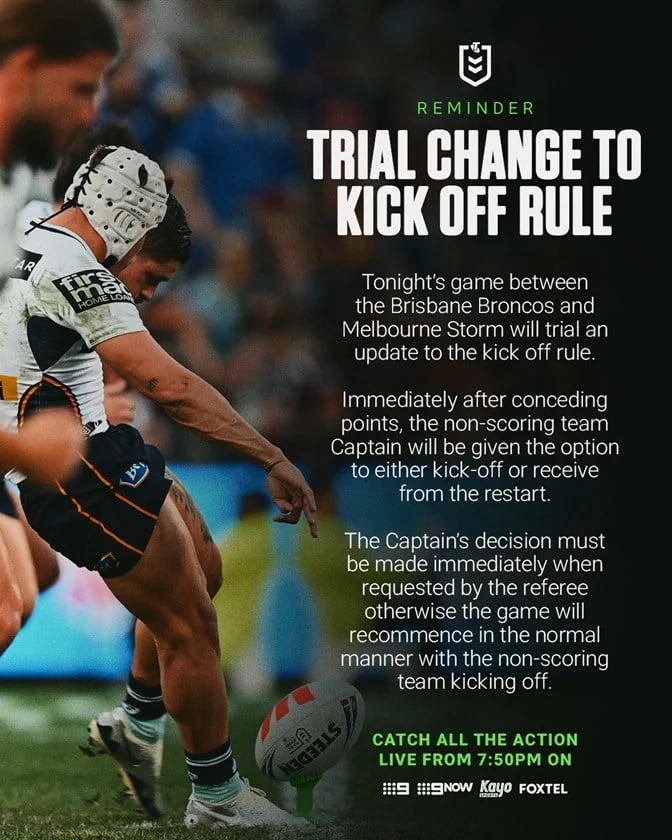
The notice published inside the NRL's coverage also explains a practical detail: the captain must make the decision immediately when the referee requests it. Otherwise, play restarts in the usual way, with the non-scoring team kicking off. That requirement matters to the spectator. A familiar restart can reflect the retained default; the trial does not require a lengthy discussion after every score.
Later, the match log records Melbourne choosing to receive and then fumbling the kick-off, putting Brisbane back on attack. That passage illustrates why the option should not be described as possession delivered without risk. The decision can change which team is asked to receive. It cannot perform the reception for them or remove the consequences of an error.
ABC's live coverage also tracked the choices, initially noting both sides favouring the familiar approach and discussing territory against possession. That is a useful football lens. It is more informative than asking only whether the winning side ever used the new option. A winning team can execute one decision poorly; a losing team can make a sensible decision and still be outplayed elsewhere.
For a meaningful review, record the score and clock at the decision, the number of players on the field, the selected option and the next phase. Then compare similar situations rather than assemble a highlight reel of the most dramatic moments. The first match offers examples worth studying. It does not provide a controlled experiment capable of settling every claim about momentum, entertainment or competitive balance.
The argument is also about when rules are tested
Supporters can understand the mechanism and still dislike the process. A temporary rule inside an ongoing season asks players and viewers to recognise that two matches in the same competition may operate differently. The question is not only whether the idea might work eventually. It is whether the purpose, boundaries and method of the test are clear enough for the people taking part.
The ARLC's decision to use matches without a bearing on finals qualification provides one answer to the timing problem. It reduces a particular competitive concern. It does not make the games meaningless to the players or supporters, and it does not mean the circumstances will match a close finals contest. The selection of the test games belongs in the assessment of what can be learned from them.
There was identifiable player opposition. ABC's post-match coverage reported Harry Grant objecting to changing the restart and questioning whether another rule was being introduced to counter an earlier change. That is a substantive argument about the direction of the game. It is not a finding that every player holds the same view, nor proof that using the option during the match would make his criticism inconsistent. A captain can use the available rules while disagreeing with their introduction.
In the historical supporter discussion of extending the trial, commenters also questioned the problem being solved and whether six-again changes should be examined instead. Other comments debated the actual decisions in the first test. Those posts show several strands of criticism in a self-selected forum. They do not establish a measured national verdict on the proposal.
A useful test needs more than a memorable scoreline
A strong review starts by stating the problem. Is the aim to increase tactical choice, change possession after points or reduce a particular kind of repeated pressure? Those aims would require different evidence. Without that distinction, almost any exciting passage can be called success and almost any error can be presented as failure.
Communication deserves a place alongside match statistics. Could captains respond promptly? Could officials administer the decision consistently? Did spectators understand why the next restart differed? A mechanism might be tactically interesting while still requiring clearer explanation. Equally, unfamiliarity in an early test is not, on its own, proof that the idea is unworkable.
The fair conclusion leaves room for both curiosity and scrutiny. Testing an option can produce information that a theoretical argument cannot. It also creates an obligation to explain what that information shows, what it cannot show and how it informs the next decision. The standard should be more demanding than finding one match whose score happens to suit an existing opinion.
A trial is not a confirmed rule for 2027
The February decision and August match notice establish a 2026 experiment. They do not establish a confirmed competition-wide change for 2027. That is the important answer for supporters looking ahead on 2 November 2026. A proposal can be considered, tested and debated without every later stage being automatic.
The February announcement's scope was explicit, and the August match notice was specific to a trial game. Neither should be turned into a claim that the next season has already adopted the option. Equally, the decision not to introduce it at the beginning of 2026 should not be turned into a claim that the league can never consider it again. Both shortcuts remove the decision which still needs its own evidence.
Read the applicable notice before judging a restart
Start with the competition and season. A men's NRL trial does not automatically establish the rules for NRLW, State of Origin, the World Cup or another rugby league competition. Then identify the match and any announced trial conditions. Familiar shirts or a familiar television commentary team are not a substitute for that scope.
Next, distinguish the underlying law from a later NRL interpretation or temporary instruction. An older rule book is useful for understanding the ordinary restart, but it cannot erase an authorised change applying to a particular fixture. Conversely, a photograph of a trial notice is evidence of that notice, not a timeless replacement for the normal law. The date and context belong beside the wording.
For the restart itself, watch which team conceded and whether the captain selects the alternative when asked. In the August notice, an immediate decision was required or the ordinary restart followed. That means a kick by the conceding team was compatible with the trial. It should not be treated as proof that an official had forgotten the experiment.
Once a new season's formal requirements are published, check what was actually adopted, its commencement and its boundaries. Do not assume that a headline saying the idea was supported answers every administrative detail. A clear explanation should tell fans what applies, rather than ask them to infer the rules from a prediction about what the Commission might prefer.
The 2027 draw and club pages will help supporters locate the football. The applicable rule notice answers a different question about how that football is played. Keeping those sources separate avoids a common mistake: treating the arrival of a new fixture list as confirmation that every proposed on-field change has arrived with it.
The worthwhile debate can then stay on the football. The trial offered a genuine decision between the next possession opportunity and the familiar kicking assignment. Supporters can question whether that decision improves the game, how it was tested and how it should be explained. Those arguments become stronger when they begin with the actual option and its limits, rather than with a version of the rule that has never been announced.
Join the conversation
Have a question or a matchday tip to share? Keep it friendly and on topic. Comments appear after review.
No comments yet. Start the conversation.
Sign in with Google to leave a comment.