The wildcard discussion is a proposal, not the current finals draw
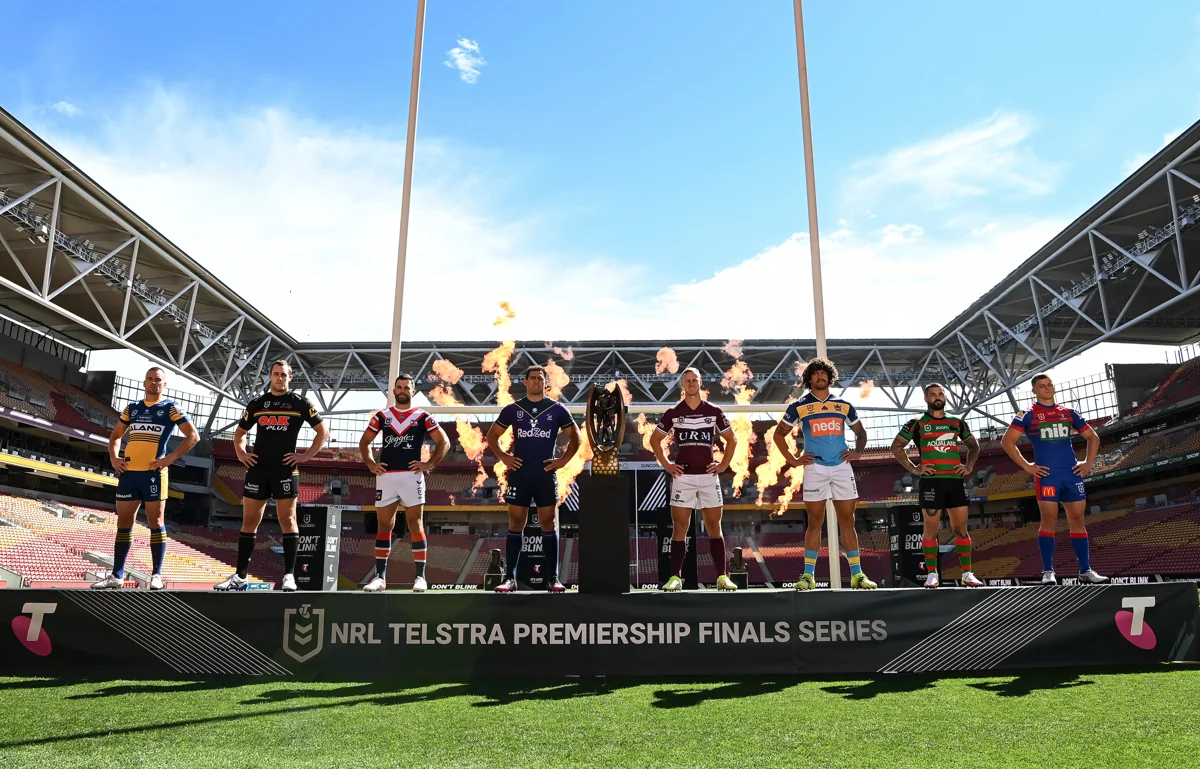
Cover photograph: the NRL's 2021 finals launch, showing the eight club representatives and premiership trophy. It illustrates the established eight-team stage and does not identify 2027 qualifiers.
A wildcard weekend would change what it means to finish seventh or eighth in the NRL. That is the important football question behind the extra matches: how much certainty should a long regular season earn, and how much opportunity should remain for the clubs just outside the existing cut?
Before arguing about the answer, keep the status clear. October reporting describes a concept being discussed with clubs, with possible introduction in 2027 or 2028. It should not be read as a published 2027 competition rule. A proposal can be seriously considered and commercially attractive without every detail having been adopted.
Zero Tackle's 14 October report attributes the consultation to reporting by Code Sports and says clubs' feedback would be considered before the draw release. SEN's 16 October discussion describes the additional two-game concept while presenting Corey Parker's alternative preference. These are accounts of a debate, rather than the final rules document governing next season.
The baseline is the eight-team finals system used in 2026. The NRL's own September coverage identifies eight title contenders entering that year's finals. The existing finals-format guide explains how those eight progress through four weeks and nine matches, with a first-week second chance for the top four.
That distinction matters for a supporter reading a new season calendar. The existing guide explains the system it covers; it is not an announcement that a proposed extra week has been inserted. Conversely, the appearance of a wildcard headline should not lead somebody to rewrite the current bracket before the league publishes a decision.
There are several decisions inside what sounds like one change. Who gets access to the extra round? Who hosts? How are its winners placed in the next stage? What happens to the timing of the established finals weeks? The broad concept is understandable before all those answers exist, but the practical consequences depend on them.
It is also worth separating the question of adoption from the question of merit. Calling the idea a proposal does not make it unserious. Supporting it does not prove that the final implementation is settled. A useful discussion can test the principle now while insisting that the details be made explicit before clubs and supporters organise a season around it.
The strongest way to follow the debate is therefore to hold two thoughts together. An additional gateway could keep more clubs in contention and create more sudden-death football. It could also reduce the reward attached to finishing inside the current eight. That exchange, rather than the borrowed label from another sport, is what the NRL needs to justify.
How the reported two-match gateway would work
The version described by SEN is a two-match gateway: seventh plays tenth, and eighth plays ninth, with the winners taking the final two places in the eight-team stage. That is the reported structure being discussed here. It is not an announcement of actual 2027 opponents, grounds or dates.
The appeal of the description is its simplicity. Ninth and tenth gain a route that does not exist under the current top-eight cut. Seventh and eighth retain a route but have to survive an additional match before reaching the established stage. The price of adding opportunity below the line is removing certainty from the two places immediately above it.
| Regular-season place | Reported gateway opponent | Meaning of that extra match |
|---|---|---|
| 7th | 10th | Must win to claim one of the remaining places |
| 8th | 9th | Must win to claim one of the remaining places |
| 9th | 8th | Receives an opportunity outside the current cut |
| 10th | 7th | Receives an opportunity outside the current cut |
Two winners still need a clearly defined place in the bracket
The table is enough to understand the principle, but not enough to construct every subsequent opponent. A final announcement must explain how the two winners are placed in the next bracket. Does their regular-season order determine which becomes the higher remaining seed? Are the paths otherwise fixed? Those are implementation questions, not details to invent because another code uses a familiar answer.
For example, imagine the seventh-placed side and ninth-placed side both winning their gateway matches. Two clubs have advanced, but a viewer still needs the published seeding rule to know their exact next assignment. A guide can illustrate that uncertainty without pretending that the hypothetical is an actual draw or that the winners carry a guaranteed particular number.
The existing system shows why the answer matters. In the top-eight format, fifth meets eighth and sixth meets seventh in first-week elimination finals. The top four play qualifying finals, where a loss does not immediately end the season. Placing the gateway winners into the lower two positions therefore connects them to opponents who have earned a different route through the regular-season ladder.
This is also why calling the proposal a ten-team finals series can obscure a useful distinction. Ten clubs would have a continuing opportunity, but they would not all begin with the same protection or number of matches required. Some would face the new elimination step. Others would enter the later stage without playing it. The distribution of advantages matters as much as the headline participant count.
Until the rules are approved and published, use the two-match description to understand the trade-off. Use the official decision, rather than a reconstructed social-media bracket, to plan the actual finals path.
The strongest case for expansion is also its trade-off
Expansion supplies the strongest football argument for reviewing the cut-off. Perth's entry changes the size of the competition, even if the number of finals places stays still. The official announcement of the Bears as the eighteenth club for 2027 gives that discussion a concrete starting point. It does not, by itself, decide what proportion of clubs ought to keep playing.
More clubs can stay involved
With eighteen clubs, an eight-team cut allows about 44.4 per cent of the competition into that stage. Giving ten a continuing route raises the proportion to about 55.6 per cent. These figures are simple arithmetic, not a prediction of the quality of the clubs finishing ninth and tenth. They explain why reasonable supporters can see the same proposal differently: one sees a competition growing around an unchanged gate, another sees more than half the field keeping a chance.
A wider race can give a late-season match a sharper purpose. Imagine a club entering its final few games close to tenth but well behind eighth. A new gateway could change what those games mean to its supporters and players. The match would still have to be won on the field; a ladder position would still have to be earned. This is the case for the idea at its strongest, without needing a claim that every extra match will sell out.
That argument also needs a limit. An extra qualification target does not make every team competitive, cure an uneven draw or produce a genuine premiership contender. A system can improve the race around tenth while doing little for the fight at the top. The league would need to explain which outcome it wants and how it would judge success beyond the existence of two more fixtures.
Seventh place would buy less certainty
Consider the same change from seventh. Under the established cut, that club has reached the eight-team finals. Under the reported gateway, it could lose one match to tenth and never reach that stage. The better regular-season finish would still determine its position, but would no longer carry the same assurance. The opportunity gained by ninth and tenth has a corresponding cost for seventh and eighth.
This does not settle the argument against a wildcard. Rugby league already asks clubs to survive elimination matches after months of work. It identifies the decision that administrators must defend: moving that elimination risk forward for particular ladder positions. If a higher finish brings a home-ground advantage or another protection, the published rules should say so. Those safeguards cannot simply be assumed.
The supporter discussion around the proposal reflects this disagreement. Some contributors worry about weakening the regular season; others welcome a longer race or more elimination football. That is a useful picture of competing values, with no claim that a Reddit thread represents the whole supporter base. The important question is what a finishing position should earn, rather than whether change is automatically progress.
An extra week could be used for a different purpose
There is a second debate inside the wildcard discussion: if the calendar can accommodate another week, where should that week go? A gateway before the eight-team stage and a break before the Grand Final are different uses of time. Supporting one does not require supporting the other, and rejecting a wildcard does not mean defending every detail of the current calendar.
Corey Parker's alternative, reported by SEN, is a week off before the decider. The former representative forward argued for that break rather than widening the finals field. His preference puts the focus on preparing the final two clubs instead of providing another qualification opportunity further down the ladder. It remains a commentator's proposal.

For a supporter, the distinction changes the entire conversation. A wildcard offers more elimination football and a broader late-season race. A common break before the Grand Final offers time between the preliminary finals and the decider without changing who qualified for the eight. Neither description proves that the football will be better. They identify different priorities that should be argued openly.
The place of a break also matters to the shape of each club's run. Under the established system, a top-four team that wins its qualifying final already skips the semi-final week. A lower-ranked survivor follows a different route. Adding a common pause near the end would not erase the earlier difference in matches played. Equally, giving some clubs a week without a game before the existing finals stage would not mean every contender has the same preparation sequence.
That is why the whole calendar must be visible. Count the matches and gaps along each possible path rather than treating an extra week as a free benefit. Ask when the regular season ends, how the preliminary finals are arranged and where the decider sits. Without those answers, it is easy to praise more recovery time while overlooking a different club's longer elimination run.
There are practical questions beyond the dressing room too. A travelling supporter needs enough notice to arrange work and accommodation. A club needs to know when it might host a match. Those questions can be asked without assuming a particular effect on performance, injuries or ticket demand. An extra week is a scheduling choice with consequences, not evidence that every problem has been solved.
The useful demand is therefore a clear explanation of purpose. If the league wants a wider qualification race, it should defend that choice on its merits. If it wants a different preparation window for the decider, it should explain that separately. Packaging both under the broad promise of a better finals series leaves supporters arguing about different things.
What a credible final announcement must explain
The eventual decision should be judged by how clearly a supporter can follow the competition from the last regular-season round to the trophy presentation. A statement that a wildcard is exciting, successful elsewhere or good for expansion cannot substitute for a usable explanation of the route. Rugby league's ladder has to mean something precise once the games begin.
Start with the effective season. A proposal considered for 2027 or 2028 does not become a 2027 rule through repetition. Then identify the number of clubs that retain an opportunity, the point at which they enter and the protections attached to each finishing position. That is the difference between understanding the competition and merely remembering a new marketing name.
Read the competition rules before buying the narrative
A useful final announcement would let a fan answer these questions without borrowing a bracket from another sport:
- Which season adopts the change, and is the decision final?
- What happens to clubs finishing seventh through tenth, and how are gateway winners seeded?
- Which ladder positions receive a home match, and who confirms the actual stadium?
- How does each winning or losing path connect to the next round?
- Where does the extra week sit, and what are the confirmed dates and kick-off times?
- What remains unchanged for the top four, including their existing first-week protection?
Each answer affects another. A promise of a home match needs a venue rule. A gateway result needs a place in the next bracket. An extra week needs a position in the calendar. A supporter should be able to trace a hypothetical club through the whole system and know which statements are rules and which are illustrations.
For the established baseline, the NRL finals format guide explains the men's top-eight system used in 2026. It should be read with that season label in mind. The 2027 draw page is the place to check the new season's actual schedule when confirmed fixtures are available; a proposal discussed in the media is not itself a match listing.
Watch the wording of fixture labels as well. An elimination final, a qualifying final and a preliminary final are different stages with different consequences. Adding a gateway makes clear labels more valuable. A broadcast graphic that says only finals football does not explain whether a loss ends a season or whether a winner has secured entry to a later stage.
The proposal deserves a proper argument, because both sides are defending something recognisable. More clubs can have a reason to keep chasing. A hard top-eight cut can preserve the reward for a better regular season. The league's task is to explain the balance it chooses, including the cost to the clubs near the existing line. Until that decision and its rules are published, supporters can debate the idea confidently while keeping a reported possibility separate from the competition they will actually watch.
Join the conversation
Have a question or a matchday tip to share? Keep it friendly and on topic. Comments appear after review.
No comments yet. Start the conversation.
Sign in with Google to leave a comment.